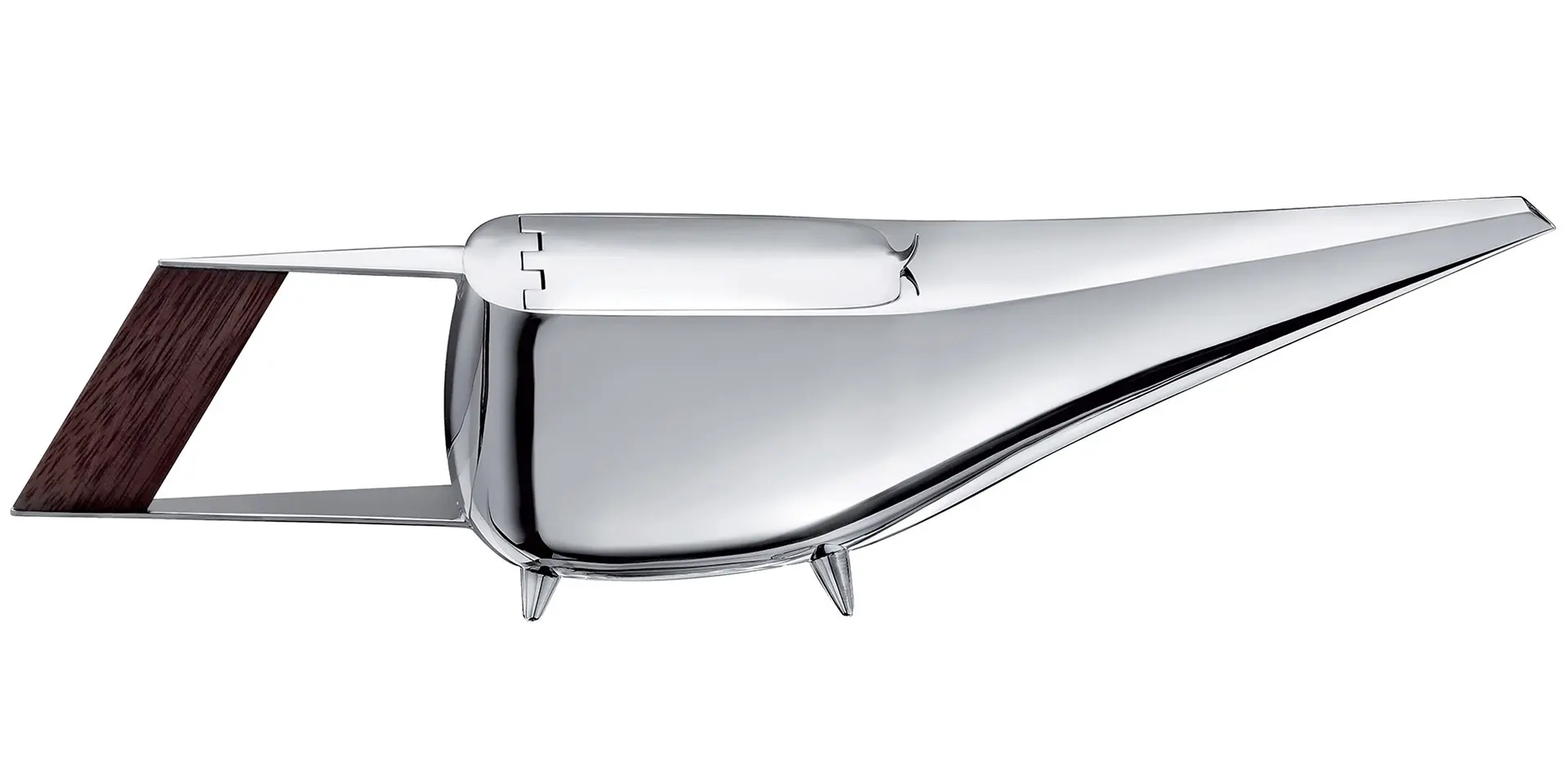
Tutto Ponti, Gio Ponti archi-designer – Musée des Arts Décoratifs
Regarded as one of the most influential architects and designers of the 20th century, Gio Ponti (1891–1979) is celebrated at the Musée des Arts Décoratifs in his first retrospective in France. A prolific creator, as interested in industrial production as in craftsmanship, he revolutionised post-war architecture while opening up new perspectives on the art of living.
Presented in the museum’s nave, the exhibition Tutto Ponti, Gio Ponti archi-designer covers his entire long career, from 1921 to 1978, highlighting the many aspects of his work, from architecture to industrial design, from furniture to lighting, from founding magazines to his forays into glass, ceramics and silverware. More than 500 pieces, some of which have never before left their original location, trace this multidisciplinary journey combining architecture, furniture, and interiors for private residences and public buildings (universities, cathedrals). The exhibition design was entrusted to the agency Wilmotte & Associés, in collaboration with graphic designer Italo Lupi. While Gio Ponti is admired today by an informed audience of design enthusiasts and highly sought after by collectors, his work remains little known in France. This exhibition is therefore an opportunity to introduce the general public to the creative world of this legendary figure of the Italian scene, whose generosity and enthusiasm stimulated his contemporaries and continue to inspire new generations of designers and architects.
A graduate of the Politecnico di Milano, Gio Ponti opened his architecture practice in 1921, initially adopting the principles of classically inspired architecture with the villa on Via Randaccio in Milan. Appointed artistic director of the Richard-Ginori porcelain manufactory in 1923, he overhauled its approach to mass production, applying it to all of the company’s creations. His neoclassical pieces won awards at the 1925 International Exhibition of Decorative Arts in Paris.
The following year, he designed his first building abroad, the villa L’Ange volant near Paris, and collaborated with Christofle in Paris and Venini in Murano. At the same time, Gio Ponti created a range of affordable, simply designed furniture for the Italian department store La Rinascente, making the decorative arts accessible to as many people as possible.
Through his ties with the Labirinto movement, which brought designers and manufacturers together, he spread his ideas and promoted new talent through the exhibitions he organised at the Monza Biennale and above all through Domus, the magazine he founded in 1928.
In the 1930s, he took a modernist turn in architecture with the construction of the Case tipiche and the offices of the Montecatini company in Milan. In the domestic sphere, he designed lighting for Fontana Arte, cutlery for Krupp, fabrics for De Angeli-Frua and Ferrari, furniture for Casa e Giardino, and more.
During the 1940s, Gio Ponti devoted himself to creating monumental frescoes at the Palazzo del Bo of the University of Padua. He returned to oil painting and to his passion for writing, opera and cinema, creating new scenarios, stagings and costumes for La Scala in Milan. After the war, as a key protagonist of “Made in Italy”, he promoted Italian design abroad through Domus and the exhibitions he organised. Two iconic objects emerged during this period: the aerodynamic La Cornuta coffee machine (1949) for Pavoni and the Leggera chair (1951) for Cassina.
From 1950 to 1960, at the height of his career, Gio Ponti spread his style through major private architectural commissions in Venezuela, the United States, the Middle East and even Hong Kong. It was then that he completed two of his masterpieces, the Villa Planchart in Caracas and the Pirelli Tower in Milan. Lightness, transparency, clarity, colour and simplicity were the watchwords of this prolific activity, which he led from his headquarters in Milan, a veritable creative laboratory. He designed numerous objects and pieces of furniture, including the luminous panel for Lumi and the Distex armchair for Cassina (reissued by Molteni&C since 2012).
In 1957, the Superleggera chair (a variant of the Leggera), one of the lightest chairs in the world, became the icon of his furniture design.
Gio Ponti was particularly interested in the interplay of surfaces and colours, working to make walls no longer load-bearing but borne, airy, as if suspended. He favoured ceramic cladding that captured light and reflected it back, as at the Parco dei Principi hotel in Sorrento.
In the 1970s, still in pursuit of transparency and lightness, he conceived his architectural façades as folded sheets of paper pierced with geometric openings, as seen in Taranto Cathedral (1970) and the Denver Art Museum (1974). Furniture was also rethought, becoming more flexible, mobile, light and luminous in order to adapt space to the needs of contemporary life.
The exhibition “Tutto Ponti, Gio Ponti archi-designer” presents, in chronological order, the six decades of Ponti’s career in architecture, design, interior design and publishing. An evocation of Taranto Cathedral, a late masterpiece, introduces the exhibition, which then unfolds in three parts: the object, furniture and architecture.
Finally, six period rooms conclude the exhibition with spectacular reconstructions highlighting the all-encompassing nature of his work. The garden-side gallery looks back at his collaborations with major manufacturers of decorative art objects, Richard Ginori, Christofle and Fontana Arte, as well as with craftsmen and small businesses. Ceramics, glass and silverware sit alongside works in papier-mâché and enamelled copper.
In the nave, the backbone of the exhibition, five sections showcase major commissions, furniture, lighting and textiles, while his architectural projects are presented chronologically through drawings, models, photographs and period films.
Lastly, on the Rue de Rivoli side, six settings have been designed, one for each decade, to showcase Gio Ponti’s creations: L’Ange volant, the Montecatini building in Milan, the Palazzo del Bo at the University of Padua, Gio Ponti’s own home on Via Dezza in Milan, the interiors of the Parco dei Principi hotel in Sorrento and, finally, the Villa Planchart in Caracas.
Gio Ponti remained committed to the very end to his idea of the “Italian-style house”, which he saw as the ultimate expression of a genuinely modern and international civilisation. The slogan “from the spoon to the skyscraper”, attributed to the Italian architect Ernesto Nathan Rogers (1909–1969), perfectly captures the personality of the Milanese architect, whose projects could range from the infinitely small to the infinitely large.
On its own, it sums up the breadth of Ponti’s field of exploration, without exhausting the richness and originality of a joyful, colourful and highly personal body of work.
DURATION : October 19, 2018 to February 10, 2019.
LOCATION : Musée des Arts Décoratifs
MORE INFO : click here
Faculty:Interior Design